A themed game festival groups a mechanic; it does not rank quality
A festival page can be a useful way to browse a mechanic without being a list of the best games. Read what unites the event before interpreting participation as an award. Then describe the action you want to do in a game, so that the event’s theme becomes a starting point for discovery.
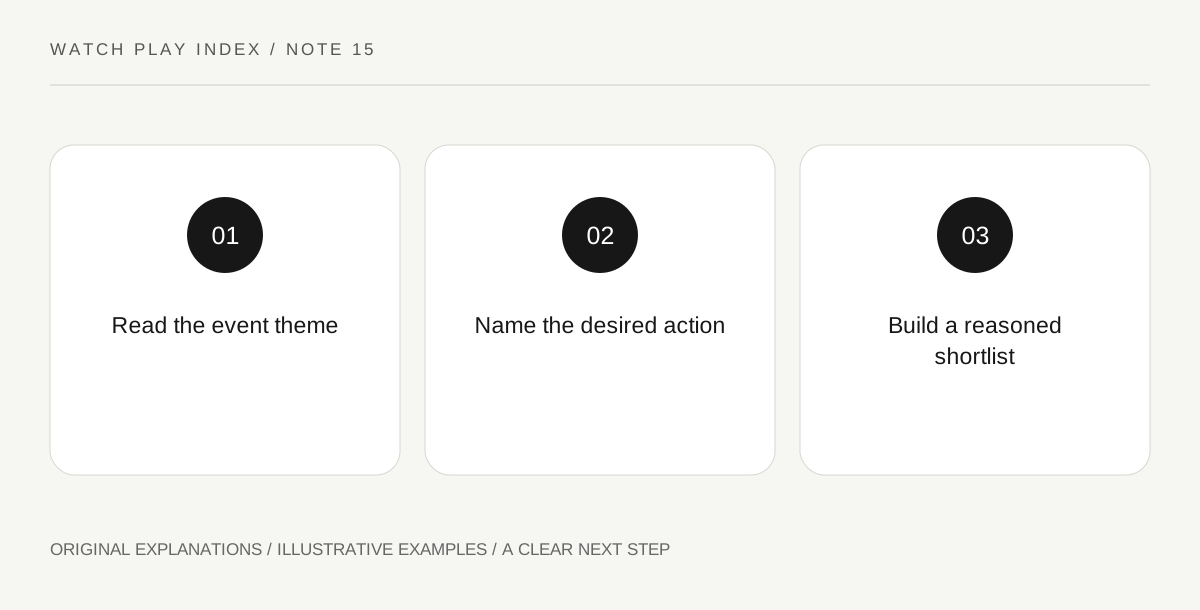
Original explanatory diagram. Read the full method and limitations below.
Read the organizing theme
Steam’s themed-event documentation describes selection around a game’s primary theme or mechanics and relevant store information. That makes the event a category-based collection, not automatically a quality ranking. A racing event is organized around an activity, while an individual player may care about a very particular version of that activity. Begin by naming the event’s stated theme, then keep any separate award or ranking claim dependent on its own explicit evidence.
Translate the theme into a player action
Write a sentence beginning with the action you want to spend time doing. For an invented racing interest, that might be learning a compact time-trial route rather than managing a championship or competing online. Those experiences can share a broad label while feeling different. Compare the game’s own description and representative footage with the sentence. This is more informative than assuming every participant in the themed event will meet the same personal expectation.
Keep promotional placement separate from suitability
A large banner or a prominent position can attract attention, but it does not explain why the game would suit your available time, preferred pace or tolerance for competition. Use it as a route to the actual title information. Do not infer that an unfamiliar title is poor because it appears lower on a page, or that a highlighted title is universally appropriate. The event can introduce possibilities while the individual decision still depends on the particular game.
Leave room for a deliberately short shortlist
Choose a small number of titles that answer different versions of your interest. Write one reason for each rather than collecting dozens of names under the event label. A title that fails the action sentence can remain interesting for a different future mood without entering this shortlist. The point is to discover a coherent next question, not to buy or try everything before the promotional window ends. Participation itself should not create urgency to make an unrelated choice.
An illustrative reader exercise
Imagine a visitor browsing a fictional strategy festival. They want short logistics puzzles, not long competitive campaigns, so they compare titles by that specific action and session shape. Their shortlist contains two distinct possibilities and no claim that the festival certified either as best. This invented exercise demonstrates using a theme for discovery without turning the page into a quality league table.
Questions that come up
Does event participation mean a game won an award?
No. A themed collection and an award are different claims. Look for an explicit award statement and its criteria before describing participation that way.
Should every title sharing a theme enter the shortlist?
No. Compare the actual mechanics, pace and session shape with your interest. A small list with distinct reasons is easier to evaluate than a long list joined only by the promotional label.
References and scope
These sources support the factual background. Examples and exercises are original illustrative teaching material. References do not imply endorsement.
- Steamworks — themed sale events — Event inclusion based on primary mechanics, themes and relevant tags.