Read an Early Access roadmap with delivered and planned work in separate columns
A roadmap can explain a developer’s direction without guaranteeing a particular future game. When reading Early Access news, distinguish what the current build already offers from what the team hopes to add. The two-column habit makes progress understandable without turning every attractive plan into a completed feature.
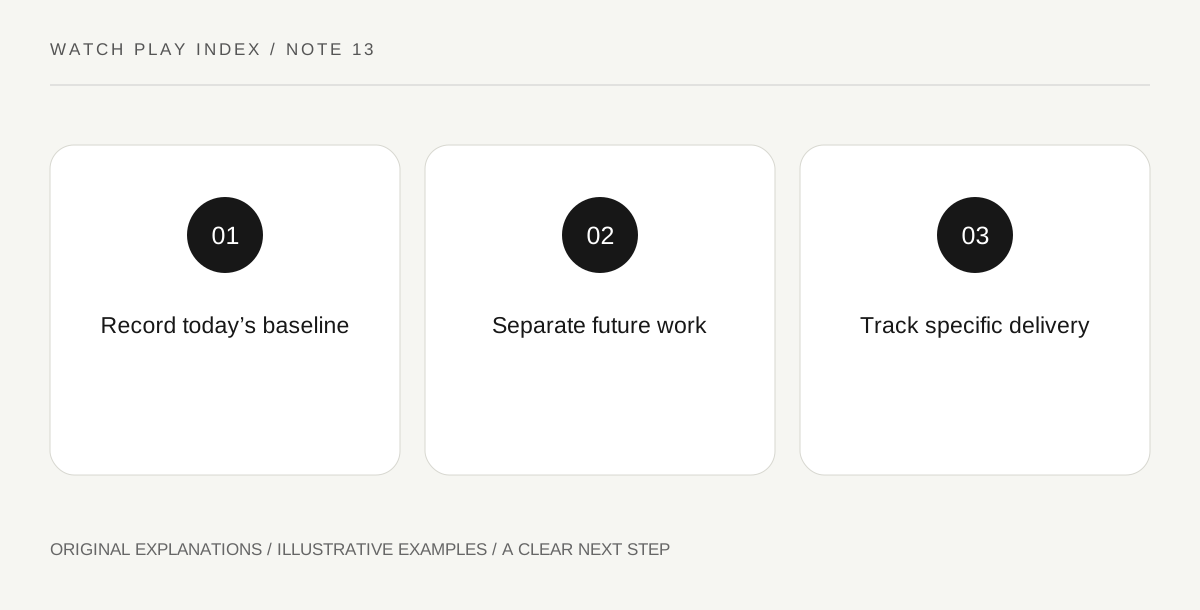
Original explanatory diagram. Read the full method and limitations below.
Begin with the current playable state
Valve’s Early Access guidance emphasizes the game’s current state and warns against relying on promises of future events. Read the actual available feature description before the roadmap. In your note, record what the present release says it includes, with its version and date. That is the baseline against which later progress can be understood. Starting from a future illustration can make the current product seem more complete than the accompanying information actually describes.
Keep plans in their own column
A planned mode, region or narrative chapter belongs in a future-work column until a release note establishes delivery. Preserve the developer’s degree of certainty: a tentative idea and a scheduled announcement are not identical. Do not strengthen cautious wording when paraphrasing it. You can find the direction appealing while leaving its outcome open. This is a reading method for development information, not a prediction that any particular team will succeed or fail.
Measure progress against the earlier baseline
When a new update arrives, compare the specific delivered item with the previous current-state note. Avoid judging an entire project only by the number of roadmap boxes or the size of a promotional image. One delivered system can require more work than several small changes, and a roadmap rarely supplies enough information to measure that effort. Describe the visible change plainly. If dates or priorities moved, record the change without inventing a reason the developer has not given.
Choose involvement at the present stage
Ask whether the current experience interests you enough to follow, play or simply watch from a distance. A person interested only in an unbuilt future feature can reasonably wait for delivery evidence. Do not turn development support into a promise of a return, guaranteed completion or a deadline that was never announced. The practical outcome is a clear relationship to the game as it exists now, with future possibilities left as possibilities.
An illustrative reader exercise
Imagine a fictional colony game whose current release contains one biome and whose roadmap proposes two more. A reader writes the first biome under delivered and the others under planned. A later update adds one of them, so the note changes only that item’s status. The invented sequence demonstrates tracking evidence; it is not a review, investment claim or assurance that a real project will finish.
Questions that come up
Does a roadmap entry mean a feature is already included?
No. Read the item’s actual status. Future-work communication and the currently playable build answer different questions and should remain separate in a summary.
Can a reader wait without deciding that development has failed?
Yes. Waiting for the feature that matters to you is a personal timing choice. It does not require a prediction about the team’s eventual outcome or a judgment based on an incomplete future plan.
References and scope
These sources support the factual background. Examples and exercises are original illustrative teaching material. References do not imply endorsement.
- Steamworks — Early Access — Current playable state and uncertainty of future development promises.