A beta announcement may describe a different branch from your normal game
An exciting feature can be publicly discussed before it reaches a game’s default version. When a report concerns a beta branch, keep that branch in the sentence. Understanding the distinction lets you follow development news without assuming every screenshot describes the game currently delivered to ordinary installations.
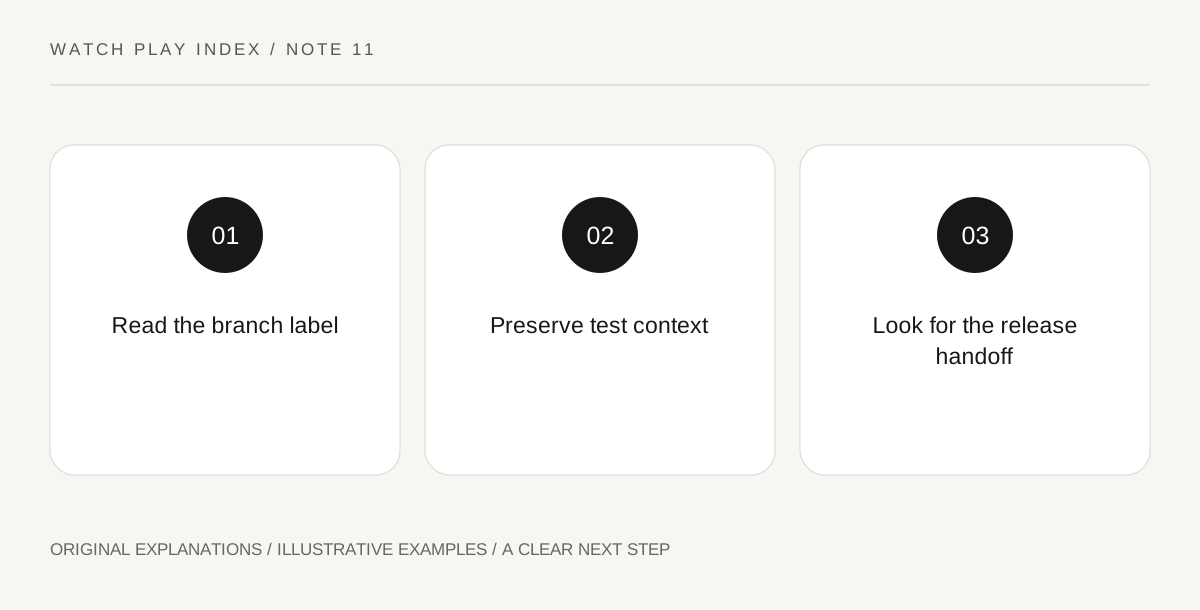
Original explanatory diagram. Read the full method and limitations below.
Treat the branch as part of the version name
Steam describes branches as particular builds that developers can make public or private, with the default branch delivered normally. Write the branch label alongside the version when summarizing news. A statement about an experimental branch is incomplete if the label disappears during sharing. The feature may be real in that context while absent elsewhere. Keeping the scope does not make the update less interesting; it makes clear which audience can actually encounter it.
Separate reading about a test from joining it
You can follow development without changing your installation. A screenshot, stream or official note may be enough to understand the direction of a project. If considering participation, read the developer’s own instructions and compatibility limitations first. A branch change replaces the installed branch, so it should not be treated as a cosmetic news preference. This guide does not instruct you to switch versions, alter saves or assume an experimental build is suitable for a current campaign.
Read feedback in its own context
A player reporting a problem on a test branch may be describing useful development feedback rather than the current default game’s behavior. Conversely, a demonstration on the test branch does not prove a default-branch issue has been fixed for everyone. Record which context each observation belongs to. If the report omits it, ask a narrow version question before repeating the result. That preserves the value of player experience without turning different installations into an apparent contradiction.
Wait for a scoped handoff announcement
When the feature moves into a broader release, look for a note that actually describes that handoff. Do not infer it solely from the number of days since a test began. A developer may revise or remove a tested idea. Keep your earlier dated note as a record of what was being tested, then add the later release evidence when available. This gives a development story a coherent sequence without inventing a guaranteed destination for every experiment.
An illustrative reader exercise
Imagine a fictional strategy game testing a new diplomacy panel on a public experimental branch. A reader shares that limited announcement and keeps playing their established campaign unchanged. Later they look for a default-release note before describing the panel as generally available. The invented example explains version-aware reporting; it makes no claim about a real branch, compatibility or a successful feature migration.
Questions that come up
Does a public beta mean every customer is already using it?
No. Public availability and default delivery are different. Read the actual branch information and keep its label attached to observations about that build.
Must a tested feature eventually appear unchanged?
No. Testing can lead to revision or removal. Follow the later official announcement rather than turning an experiment into a promise about the final game.
References and scope
These sources support the factual background. Examples and exercises are original illustrative teaching material. References do not imply endorsement.
- Steamworks — branches — Public or private beta builds, default branch and branch selection.