Steam Playtest: a signup, an invitation and a playable test are different states
A playtest announcement can invite interest without immediately admitting every applicant. Read the difference between requesting access, receiving access and finding the test playable. These states help you understand a development update and prevent a signup button from becoming an unsupported promise about tonight’s gaming session.
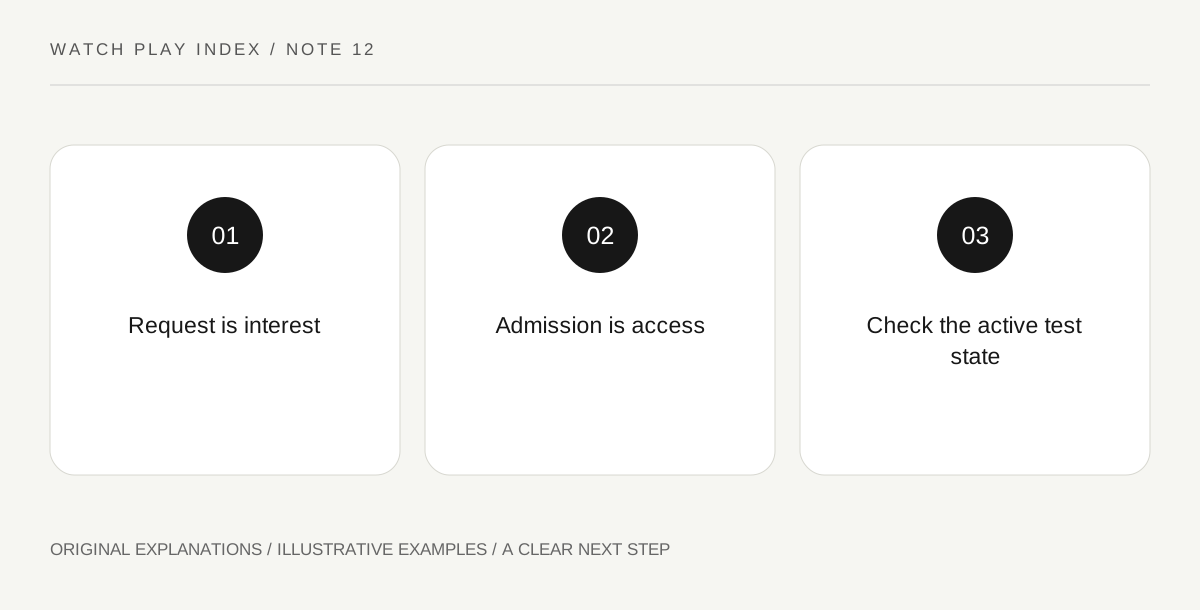
Original explanatory diagram. Read the full method and limitations below.
Identify the application being discussed
Steam Playtest uses an associated testing application separate from the main game. Keep that distinction in your note. Access to a test is not the same as acquiring the eventual release, and an update about the main game does not automatically describe the test’s current state. Read the developer’s announcement for the test name and purpose. This is particularly useful when screenshots show similar branding while the available content and access arrangements differ.
Read the admission language carefully
Valve lets developers control how many testers are admitted. A request therefore expresses interest; it is not necessarily an immediate invitation. Look for the actual access confirmation and the developer’s instructions before organizing a group session around it. Friends can be in different admission states even when they clicked the same button. Avoid interpreting that difference as evidence that one account has failed or that every request should have been processed at the same time.
Distinguish access from an active test period
A test can be made unplayable when the developer ends or pauses it. Read the current status and any time window described in the official announcement. Do not treat a past invitation as an indefinite availability guarantee. If the developer asks for feedback, understand the scope and appropriate channel before submitting observations. Keep the version and conditions in any report so that a problem can be understood as test feedback rather than a review of an unrelated later release.
Make participation a flexible choice
Choose a tentative playing plan that can change if admission or the test period does not align. A separate existing game or another activity can keep a gathering enjoyable without pressuring everyone to chase access. Do not buy a purported test invitation from an unknown seller or assume a free testing program is a paid entitlement. Follow the official route and evaluate what is actually available. Development participation is interesting, but it need not become an obligation to arrange the whole evening around uncertainty.
An illustrative reader exercise
In an illustrative multiplayer project, three friends request test access. Two receive confirmation while the third remains waiting. They avoid promising a full-group session and instead arrange a flexible alternative. After a later test period ends, they keep the experience in their notes without assuming it remains playable. This fictional example explains states of participation and does not describe any real game’s admission policy.
Questions that come up
Does requesting access prove that I have been admitted?
No. The developer can control admission. Read the actual confirmation and current test status rather than treating the request button as a completed invitation.
Does a playtest invitation guarantee permanent access to the final game?
No. Testing and the main release are separate. Consult the exact official terms and avoid turning participation in a temporary test into an unsupported ownership claim.
References and scope
These sources support the factual background. Examples and exercises are original illustrative teaching material. References do not imply endorsement.
- Steamworks — Playtest — Separate testing application, controlled admission and ability to end a test.