A streaming release date needs a clock and a time zone
A release date in an entertainment headline is not always midnight where you live. Before arranging a shared first episode, distinguish a calendar date from the platform’s stated launch time. This small reading exercise prevents a predictable mismatch from becoming a rumor that the show has been delayed.
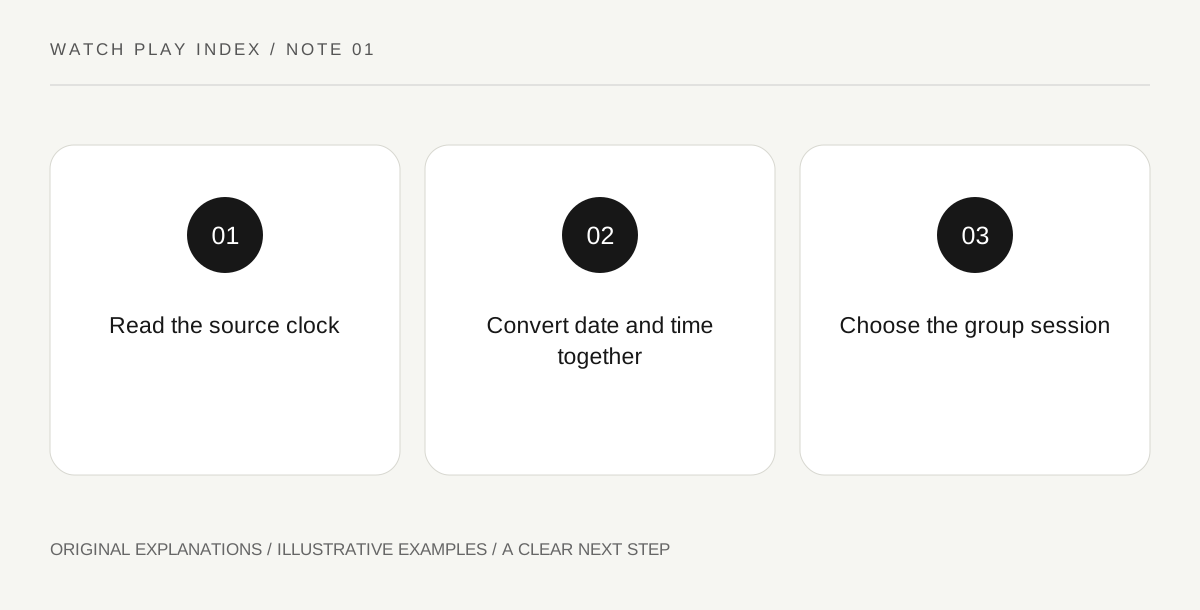
Original explanatory diagram. Read the full method and limitations below.
Identify the source clock
Netflix explains that its original films and shows typically launch at midnight Pacific Time, while title-specific launches and other arrangements can differ. Treat that as a general convention rather than a promise for every title. Find the exact title’s current details or official announcement and note whether it states a clock time. A date repeated by many fan accounts may still trace back to a single announcement that never described your local midnight.
Carry the date through the conversion
When converting a stated time, use the relevant location’s time zone for the actual release date, including seasonal clock changes where applicable. Do not permanently memorize one hour offset and apply it to every month. Record the source date and time beside the converted result so that another person can check the calculation. A conversion can cross a calendar boundary; dropping the date while copying the hour makes a technically correct number practically misleading.
Distinguish launch from your gathering
Your group does not have to watch at the instant of release. Choose a convenient session after confirmed availability and describe it as the group’s viewing time. This separates the social plan from the platform event and makes changes easier to handle. It also avoids asking people to stay awake merely because a promotional date appears urgent. The useful agreement is when your companions intend to begin, with a title that is actually available to them.
Update the conclusion only when the evidence changes
If the expected moment arrives and the title is absent, inspect the exact region, title and current official notice before announcing a delay. Netflix notes that title-specific and weekly arrangements may differ from the general rule. Keep an unconfirmed observation narrow: the title is not visible on this account at this moment. That sentence is more accurate than a global claim about a launch failure based on a single screen or an incorrectly converted headline.
An illustrative reader exercise
For an invented release, an announcement says Friday at a named source-zone time. Two friends write that original statement, use a date-aware conversion and then choose their own Saturday evening session. Their calendar entry is labeled as a social plan rather than the premiere itself. No specific conversion or title availability is asserted here; the exercise shows which pieces of information belong together.
Questions that come up
Does a calendar date alone prove a local midnight release?
No. It may describe a promotional date without defining a local clock. Find the title-specific information and the applicable platform convention before attaching a precise hour to it.
Should a shared watch session start exactly at launch?
Only if the group wants that and availability is confirmed. A convenient later session often needs fewer assumptions and can still provide the same shared first-viewing experience.
References and scope
These sources support the factual background. Examples and exercises are original illustrative teaching material. References do not imply endorsement.
- Netflix Help — release timing — Typical Pacific-time original releases, exceptions and title-specific times.