During a live stream, agree whether the group is at the live edge
Two people can open the same live event and still be watching different moments. Pausing, rewinding or starting from the beginning creates a playback position distinct from the live edge. Make that distinction before discussing what is happening, especially when friends want to react together without spoiling a delayed viewer.
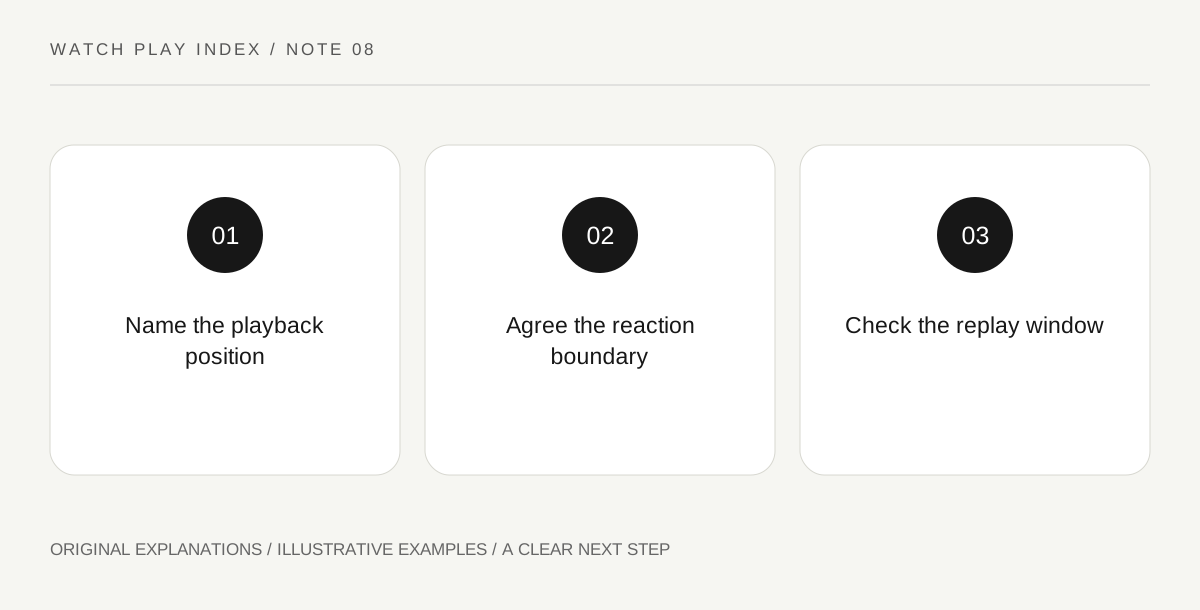
Original explanatory diagram. Read the full method and limitations below.
Name the playback position
Netflix’s live-event guidance describes pausing, rewinding, starting from the beginning and jumping to live during a stream. Ask whether each participant is watching the current live position or a delayed point. The live label identifies the event’s format; it does not prove that every person’s screen shows the same instant. A simple message that someone is a little behind can prevent a real-time reaction from revealing something the other viewer has not reached.
Choose synchrony or independent pace
A group can deliberately move to the live edge, or agree to discuss only after a shared checkpoint. Do not pressure somebody to skip content they want to watch merely to keep a chat synchronized. If people remain at different positions, keep immediate reactions in a separate agreed conversation. The useful rule is understandable and easy to follow. It need not involve comparing every second of video or pretending that internet delivery creates perfectly identical playback on all devices.
Separate the event from its later replay
The platform notes that some events have limited later availability. Confirm the exact event’s current replay information rather than assuming it becomes a permanent series episode. A replay may also be presented differently after the live period, so a later viewer’s interface is not proof of what an earlier viewer saw. When writing a recommendation, say whether you are discussing the live experience or a replay. These are related ways to watch, with different timing and conversational expectations.
End with a clear spoiler handoff
After the event, ask when delayed viewers are ready for unrestricted discussion. Keep the result or surprise out of a neutral scheduling message. A useful handoff might name a shared completion point and invite people to join when they reach it. This preserves the social pleasure of reacting together without turning a streaming feature into a rule everyone must obey. Availability questions and discussion boundaries should remain separate so that neither is mistaken for a judgment about how someone watches.
An illustrative reader exercise
In an invented concert-stream scenario, one friend pauses for a household interruption while another continues live. They agree that the delayed viewer will finish at their own pace and that immediate reactions will stay in a separate message. Later they confirm completion before discussing the closing segment. The example demonstrates conversational coordination and does not assert the availability, duration or content of any real event.
Questions that come up
Does a live event mean I must watch at the live edge?
No. Use the options supported for the actual event and your device. For a shared discussion, the important point is that companions understand their different playback positions and agree how to handle reactions.
Will every live event remain available indefinitely?
Do not assume so. The platform describes limited availability for some events. Consult the exact title’s current information before planning a later viewing or recommending it as a permanent catalog item.
References and scope
These sources support the factual background. Examples and exercises are original illustrative teaching material. References do not imply endorsement.
- Netflix Help — live events — Live-event playback, availability and device-specific arrangements.