After a Next Fest preview, carry one unresolved question toward release
A festival preview is most useful when it leaves you with a clear question about the eventual game. Steam Next Fest centers on upcoming games with playable demos. Treat the event as a discovery moment, then keep preview observations distinct from claims about a release that may still change.
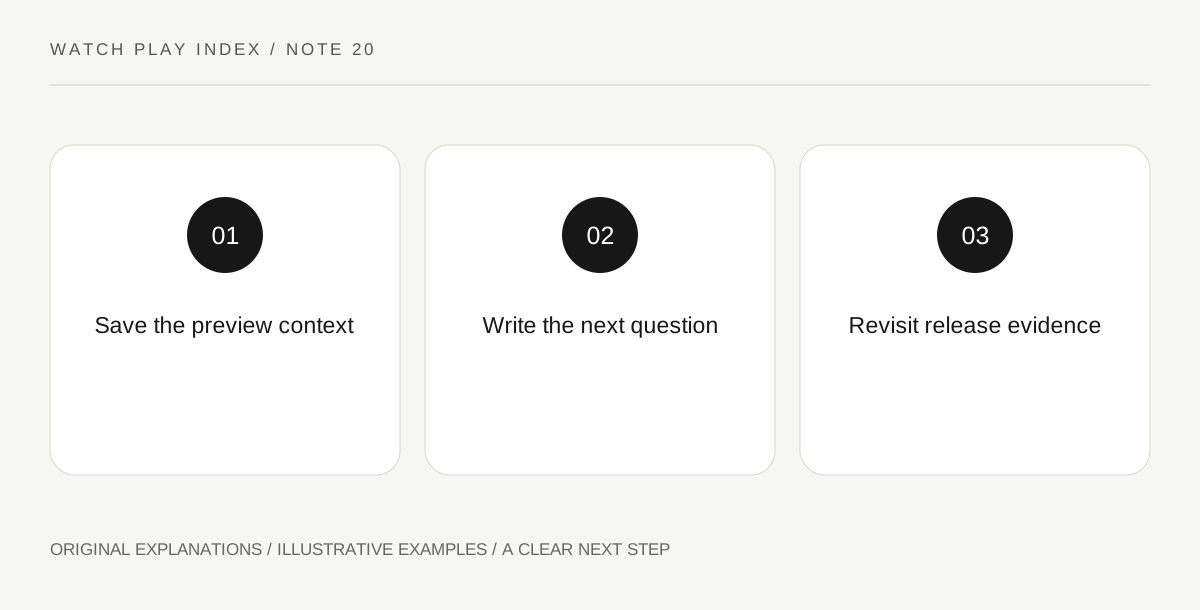
Original explanatory diagram. Read the full method and limitations below.
Record the preview context
The Steamworks description identifies Next Fest as an upcoming-game event focused on playable demos and development discovery. Save the exact edition, title and preview version where supplied. Do not remove that context when making a later recommendation. A preview can show a real interaction while representing only a selected part of the project. Its presence at an event is not an announcement that the complete game is already released or that every shown system is final.
Choose the unresolved design question
After the preview information you actually considered, ask what matters next: whether a campaign introduces meaningful variation, how a mechanic develops or what the complete session structure will be. Keep the question specific enough that later official material could answer it. Avoid a vague verdict such as the whole game will be amazing based on a narrow slice. You can record excitement as a personal response while leaving the larger design claim open.
Follow a changed answer without defending the old impression
A later developer report may show that the project has revised a mechanic or changed its scope. Compare that information with the question in your note rather than insisting that the preview must remain the permanent reference. Development can make the eventual experience more or less suited to your interests. Either outcome is useful to discover. Preserve what was observed earlier as a dated preview, then update the current decision with the applicable release information.
Let the event end without forcing a decision
A festival’s closing date does not require a purchase, a complete ranking or an immediate judgment of every interesting project. Keep a small set of questions and choose when to revisit them. Verify any real release date or continued demo availability on the title’s current page; the event description cannot promise those details for every participant. A good discovery record helps you wait intelligently instead of turning a temporary promotional window into pressure to decide about an unfinished project.
An illustrative reader exercise
Imagine a fictional logistics preview showing one compact warehouse. A visitor’s follow-up question is whether later scenarios create different routing problems rather than merely larger versions of the same layout. They save that question and revisit official release information later. This invented exercise does not report a playtest, establish demo availability or predict the quality and scope of a real game.
Questions that come up
Does a festival demo establish the complete game’s scope?
No. It is a preview with its own context. Use later applicable information for claims about the delivered release and keep any earlier impression clearly dated.
Must a discovery shortlist become a purchase list immediately?
No. A shortlist can hold questions for later. Waiting for the relevant release evidence is a valid outcome when the current preview does not answer what matters to you.
References and scope
These sources support the factual background. Examples and exercises are original illustrative teaching material. References do not imply endorsement.
- Steamworks — Next Fest — Upcoming-game event centered on playable demos and development discovery; dates require the current edition page.