A game-store broadcast can stream a recording: read the presentation context
A video playing inside a store broadcast is not automatically an unscripted demonstration happening at that instant. Steam supports live and prerecorded broadcast content. Read the presentation context before treating a smooth sequence, a chat window or a live tag as proof of a particular kind of production.
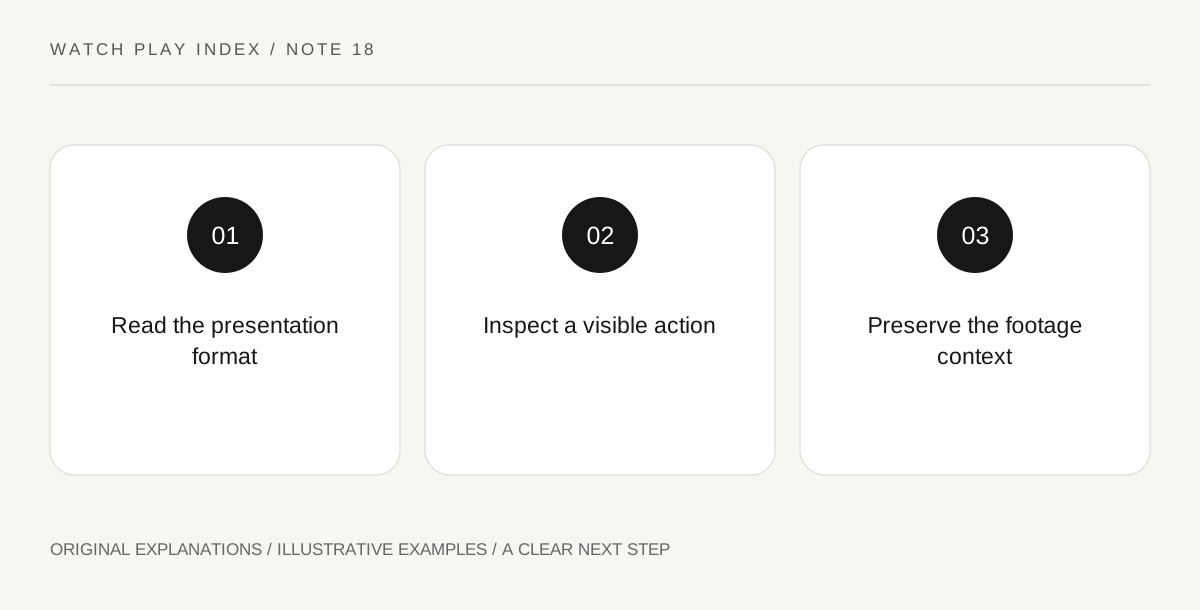
Original explanatory diagram. Read the full method and limitations below.
Separate delivery from recording time
Valve describes broadcasting as a way to stream both live and prerecorded material to a product page. The delivery can be happening now even when the footage was captured earlier. Look for the publisher’s description of the session, host and content. Do not assume a visible broadcast player establishes the footage’s capture date or the build shown. This distinction lets you interpret the video without inventing a claim of deception merely because it is a recording.
Ask what the footage demonstrates
Choose a question tied to visible behavior, such as how a menu organizes a task or how movement is represented. A prerecorded sequence can answer that question well if its scope is clear. It is less suited to establishing how a system responds to an unplanned request in real time. Keep editing, selected scenarios and commentary in mind when forming your note. The evidence can be valuable without representing every possible situation a player will encounter.
Read chat and host interaction separately
An active chat does not prove that the person visible in the video is reading it. Look for an actual explanation of whether questions are being answered live, moderated separately or collected for later. If you ask a question and receive no answer, do not immediately infer a technical fault or an intentional refusal. The format may simply be a scheduled rebroadcast. Use the official information and appropriate feedback route to understand what kind of interaction is offered.
Preserve the source context when sharing
A recommendation can say that an official broadcast shows a particular sequence, with the date or version if supplied. Avoid strengthening it into a claim that you personally watched an unedited live test unless that is actually established. If the sequence raises a useful question, follow it with a written feature description or current update note. The aim is to understand the game, not to make the video carry more certainty than its format provides.
An illustrative reader exercise
Imagine a fictional store page streaming a recorded developer walkthrough while a moderator handles chat. A viewer notes the demonstrated construction menu and reads the session description before expecting the host to react to a request. They share the walkthrough as official footage without claiming it is an improvised test. The invented example illustrates presentation context and does not describe a particular broadcast or its production history.
Questions that come up
Is prerecorded footage automatically misleading?
No. It can be an appropriate demonstration when its context is understood. The problem is an unsupported inference about recording time, editing or live interaction, not the existence of a recording.
Does a chat box mean the on-screen presenter is responding?
No. Chat and footage can have different arrangements. Look for the session description and actual interaction before drawing a conclusion about who is available to answer questions.
References and scope
These sources support the factual background. Examples and exercises are original illustrative teaching material. References do not imply endorsement.
- Steamworks — livestreaming — Store broadcasts may carry live or prerecorded content.