Netflix views: divide hours by runtime before interpreting the headline
A headline about millions of views can sound like a count of individual people who finished a title. Netflix defines its reported views through a different calculation: viewing hours divided by runtime. Work through a small invented example to understand what that metric can tell you and what it cannot establish.
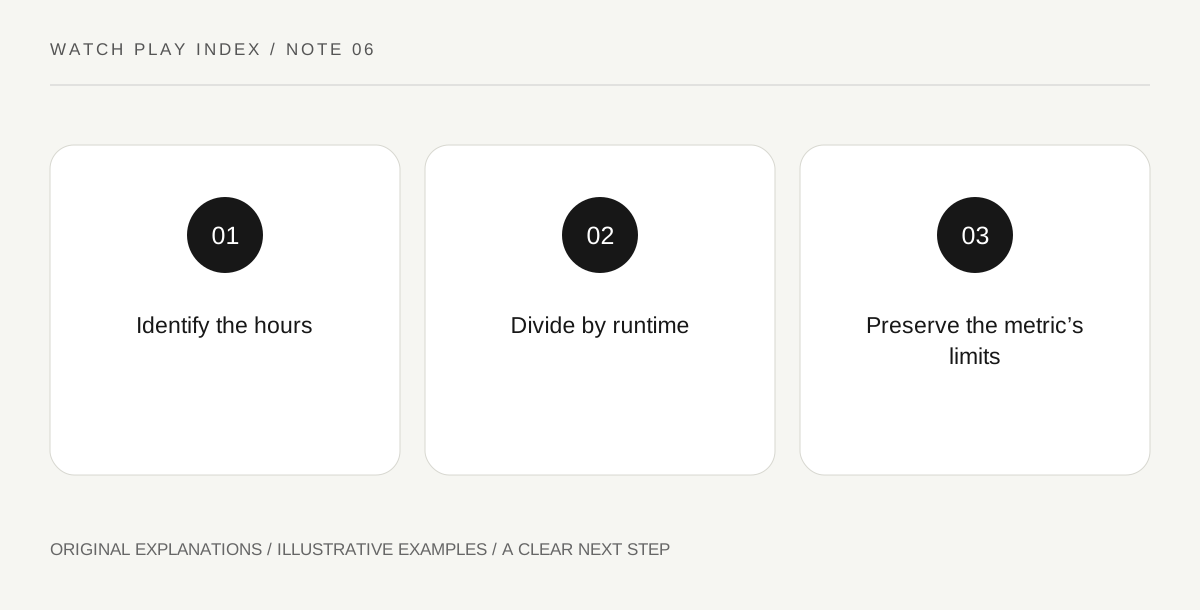
Original explanatory diagram. Read the full method and limitations below.
Keep the three quantities distinct
Netflix’s methodology update defines views as total hours viewed divided by the title’s runtime. Write the numerator, denominator and result in separate places. Hours describe accumulated viewing time, runtime describes the length used for normalization and views are the resulting metric. Calling all three audience size hides the calculation. When reading a report, keep the publisher’s metric name intact rather than silently changing it into unique viewers, households or completed viewings.
Use a simple invented calculation
Suppose an imaginary film has twelve million hours viewed and a two-hour runtime. Division produces six million normalized views. If another imaginary film has nine million hours and a one-hour runtime, its result is nine million views. The second has fewer hours but more normalized views in this example. These fictional numbers show why the ranking can change when the unit changes. They do not describe real titles, measured audiences or a prediction of either film’s commercial success.
Do not reverse the metric into individual behavior
The arithmetic alone cannot tell you how many different people watched, which people completed the title or why they stopped. Aggregated time can arise from different combinations of viewing behavior. Avoid converting a normalized total into a sentence that every counted viewer finished the story. If a report offers another metric, read that definition separately. A familiar word such as view does not guarantee that different platforms or research sources are counting the same event.
Connect the number to the decision you actually face
Popularity information can be interesting context, but it does not answer whether a title fits your preferred genre, available time or spoiler tolerance. Use the metric to understand the report, then use the official description and your own interests to choose a viewing session. If comparing performance across titles, retain the same time window and category alongside the calculation. A correct quotient is still misleading when one numerator covers a week and another covers a much longer period.
An illustrative reader exercise
In an illustrative reader exercise, a friend calls the imaginary two-hour film’s six million views six million people who watched every minute. You keep the six-million figure but change the explanation to the runtime-normalized metric. You then ask for the reporting window before comparing it with another title. The correction preserves the published unit without inventing information about individual audience behavior.
Questions that come up
Can more viewing hours coexist with fewer reported views?
Yes. The invented two-film calculation shows how a longer runtime changes the quotient. Use the actual source’s definitions and time window before making a comparison with real titles.
Does a popular title automatically suit my evening?
No. Popularity describes a defined aggregate metric, while your choice depends on interests, time and the experience you want. Use the number as context rather than a personalized recommendation.
References and scope
These sources support the factual background. Examples and exercises are original illustrative teaching material. References do not imply endorsement.
- About Netflix — Top 10 methodology update — June 20,2023 update defines views as hours viewed divided by runtime and describes the 91-day most-popular window.