A video-podcast chapter is a route into a conversation, not its whole context
A chapter title can make a long video conversation easier to navigate, but a short segment does not automatically carry everything that qualifies its claim. Use the chapter as a starting point, then inspect the surrounding discussion before quoting or sharing the speaker’s conclusion as entertainment news.
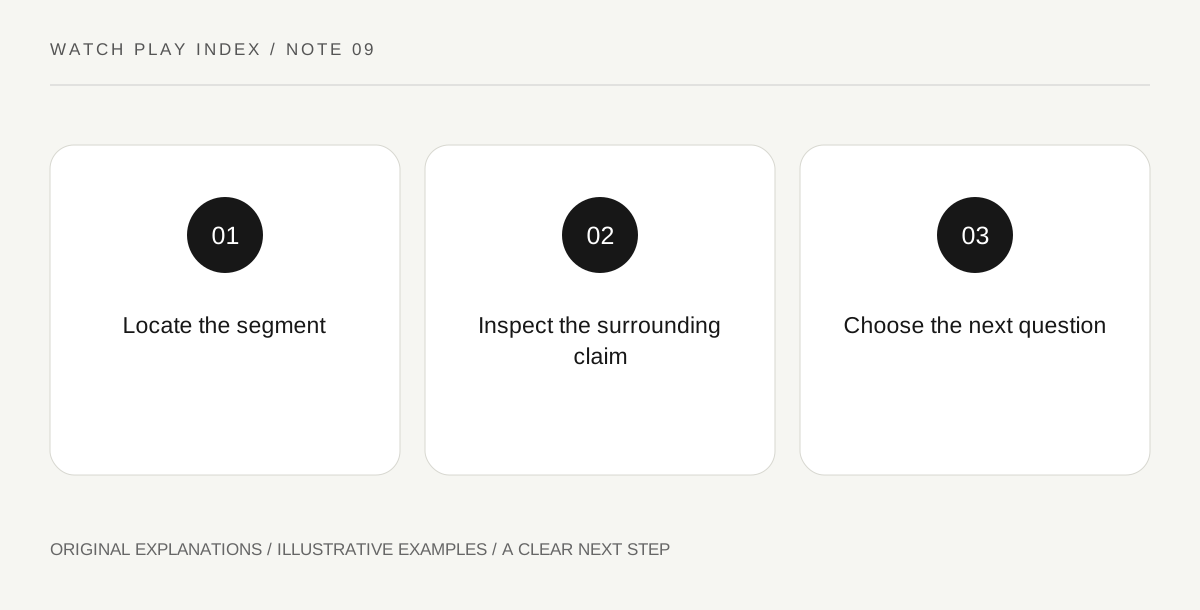
Original explanatory diagram. Read the full method and limitations below.
Use the chapter for navigation
Netflix’s podcast guidance describes chapter navigation for many episodes and title-specific release schedules. Select the topic you want to understand, then note the exact episode and segment rather than the podcast name alone. A recurring conversation series can revisit the same subject with different guests or later information. The chapter label helps you arrive at a place; it is not a substitute for identifying who is speaking and what the episode actually discusses.
Separate statement from interpretation
Write a short note with three parts: what the speaker said in your own words, the reason or example they gave and your own response. Keep those parts visibly distinct. A guest’s prediction, joke or personal recollection should not become a confirmed platform announcement merely because the episode is hosted on a streaming service. If the conversation refers to a factual release update, look for the relevant original announcement before passing it on as established news.
Read around the attractive clip
Before sharing a segment, listen to enough surrounding context to understand qualifications, questions and corrections. Do not isolate an unfinished sentence simply because it creates a stronger headline. If the full episode is too long for your purpose, keep your summary narrow and say which part you considered. You can recommend the discussion as an interesting perspective without claiming to have checked every statement or watched material you have not actually reached.
Choose the next listen from a question
After the segment, decide whether you want more background, a contrasting perspective or simply an enjoyable conversation. That decision is more useful than automatically playing every newly listed episode. Read the actual podcast schedule and title details rather than borrowing the release clock of ordinary films or series. A conversation can also be worth revisiting after later events, provided the original date remains visible so an older prediction is not mistaken for a current report.
An illustrative reader exercise
Imagine a fictional podcast guest predicting a game’s future direction in one chapter. A listener notes that it is the guest’s opinion, listens to the qualification that follows and checks the developer’s own announcement before repeating a release claim. They recommend the conversation for its perspective without presenting the prediction as confirmed news. No actual quotation, guest or release is represented in this scenario.
Questions that come up
Does a chapter title establish the speaker’s final position?
No. It is a navigation label. The discussion may qualify, question or revise the idea within the segment or nearby context; read the actual conversation before summarizing it.
Do podcast episodes follow the usual film-release clock?
Not necessarily. Netflix describes podcast-specific schedules and varying release times. Use the exact podcast’s current details instead of transferring the convention from another content type.
References and scope
These sources support the factual background. Examples and exercises are original illustrative teaching material. References do not imply endorsement.
- Netflix Help — video podcasts — Podcast release schedules and Netflix availability information.